

Disclaimer: This article was created in collaboration with lemlist, a powerful prospecting tool to automate multichannel outreach that I recommend; they sponsored this piece. It includes affiliate links, which means I may earn a commission if you book a demo or make a purchase – at no extra cost to you. These partnerships help sustain the blog and keep my content free. All insights reflect my independent analysis and commitment to sharing meaningful, practical value with the enablement and revenue community.
Quick Answer
Multichannel outreach works when each channel reinforces the same message, not when you add more touches for the sake of it. A strong sequence should feel like one coherent motion across email, phone, LinkedIn, voicemail, and any other channel you use.
Start by deciding whether a cadence is even the right route. If you have a credible mutual connection, previous user, or any other access leverage, make sure to use it. A sequence should earn its place.
When a cadence does make sense, choose the right effort level before writing messages: High, Low, or Zero personalisation. These levels define how much manual depth you apply, but it doesn’t mean lower manual effort corresponds to lower relevance. A Zero personalisation cadence can still work if segmentation is strong enough.
The most important practical step is to build the first touch properly. In many cadences, the first email becomes the anchor for everything else. The observation you use there should shape the follow-up email, the call opener, the LinkedIn message, and the voicemail.
A simple channel model is:
- Email carries the core hypothesis
- Phone tests and accelerates
- LinkedIn builds familiarity
- Voicemail points back to the strongest message
- SMS, where appropriate, creates a short, direct nudge
The mistake to avoid is disconnected outreach: one pitch in email, another on the phone, and a generic LinkedIn follow-up. Buyers experience all of it as one impression, so the thread needs to stay consistent.
If you want the full breakdown, the rest of this guide goes deeper.
Introduction
Most sellers are using more channels than ever.
Email, phone, LinkedIn, voicemail, WhatsApp in some markets, and sometimes even direct mail or gifting.
On the surface, that sounds like meaningful progress. Each channel adds another route into the account, more chances to be noticed, and more ways to create a conversation.
On the downside, more channels can also create more noise.
I’ve seen plenty of outbound motions where every channel technically exists, but they don’t work together. The email says one thing. The call sounds like a different pitch. The LinkedIn message feels like a random add-on. The voicemail asks for a call back, even though the strongest context sits in the email.
I wouldn’t define this as multichannel outreach in any meaningful sense. If that’s how you are operating, it’s closer to disconnected outreach spread across multiple places.
What’s important to realise is that buyers don’t experience your outreach as separate tasks in a sales engagement platform. They experience it as one impression of you, your company, and the relevance of your message.
If the touches feel repetitive, generic, or disconnected, the extra channels won’t help and, in fact, might hurt your outreach efforts.
This is where the broader outbound system, within which multichannel outreach sits, comes into play.
In my outbound sales strategy guide, I focused on the decisions that happen before outreach begins: who you target, how you tier accounts, how you manage active capacity, how buyer signals influence timing, and when you should open manually versus run a cadence.
Those decisions give the outreach motion direction. They are foundational elements you need to get right before you even consider building and sending multichannel outreach sequences.
This guide picks up at the next layer: how to execute that motion across channels once a cadence is the right path.
In Step 5 of the outbound strategy guide, we introduced the idea that sequencing should not be the default. When leverage exists – a strong access path, a previous user, or a clear “Now” signal – a manual-first approach often makes more sense.
But when a cadence is appropriate, we need to consider a more tactical question:
How do email, phone, LinkedIn, and voicemail work together without becoming a pile of disconnected touches?
That is what this guide is about.
We’ll look at how to develop a sensible multichannel outreach strategy, how to structure a multichannel cadence, how to define the role of each channel, how to build a strong first touch, and how to carry the same core narrative across email, phone calls, LinkedIn, and voicemail.
We’ll also zoom into the practical writing and execution layer – including manual emails, automated follow-ups, LinkedIn messages, cold calls, voicemail, and deliverability basics.
Let’s explore this in more detail.
What multichannel outreach actually means
Building on what we’ve just covered in the introduction, the core of the matter is not whether you use multiple channels, but whether those channels are working together.
A proper multi channel outreach cadence is a coordinated motion where each outreach channel plays a specific role, and all of them reinforce the same underlying idea.
In practice, that usually looks like this:
- Email carries the core hypothesis – This is where you articulate the observation, the problem, and why you are reaching out. It becomes the most complete version of your thinking.
- Phone tests and accelerates – It gives you a way to create immediacy, validate whether the message resonates with your target audience, build an initial relationship, and move faster when there is traction.
- LinkedIn builds familiarity and continuity – It helps the buyer recognise your name, see your relevance, and engage through lighter actions like profile views, connections, or content interaction before replying directly.
- Voicemail redirects attention – It rarely needs to stand on its own. Its role is often to point back to the message that already carries the most valuable information.
- SMS creates a short, direct nudge – In markets and use cases where it is appropriate, SMS can work as a brief follow-up layer inside the sequence. Interestingly, some platforms like lemlist are enabling teams to add SMS steps alongside email, calls, and LinkedIn, so SMS can act as part of the existing cadence rather than becoming a separate workflow.
The important part is how those multiple sales channels align with each other. Each touch should feel like a continuation, not a reset.
If a prospect reads your email, then hears a voicemail, then sees your LinkedIn message, they should recognise the same thread running through all of them. The idea should compound rather than change.
That’s why the first strong touch matters more than most teams realise.
In many cases, that initial message – often the first email or a well-crafted manual outreach – becomes the anchor for everything that follows. The observation you introduce there should shape how you show up on calls, how you frame your LinkedIn outreach, and how you position your follow-ups.
You are not creating new messages for different channels. Instead, you are carrying the same message through different formats.
When you approach this correctly, your outreach campaigns feel coherent from the buyer’s perspective, which means they don’t have to re-interpret your intent every time they see your name.
They simply get more chances to engage with something that already makes sense.


Sequencing should still earn its place
Before we define the multichannel cadence approach in more detail, it’s worth slowing down for a moment.
A cadence is useful when you need structure and repeatability, helping you create follow-up discipline, coordinate channels, and make sure accounts don’t disappear after one touch.
But that does not mean every stakeholder should automatically enter a sequence.
In fact, before building a cadence around a prospect, I would first ask a more important question: “Is there a better way to open this conversation?”
This is important because some situations give you leverage before outreach even begins, and if you have that leverage, putting someone into your multichannel campaigns too quickly can weaken your position.
Here are the main places I would check first to see whether you may have some leverage.
Mutual connections
If there is a credible mutual connection, start there.
This does not mean asking anyone with a loose LinkedIn connection to make an introduction. The quality of the relationship is critical.
The practical steps to take are simple:
- Use LinkedIn to identify possible connection paths
- Check whether someone in your company knows the prospect
- Look beyond your company if needed, including partners, customers, investors, advisors, or shared communities
- Ask whether the relationship is strong enough for a short introduction
- Make the introduction easy by drafting the note for them
- Keep the ask light and low-pressure
LinkedIn is useful here because it helps you see connection paths that are easy to miss.
At the account level, you can scan for people connected to your colleagues or wider network. At the individual level, you can check mutual connections directly on the prospect’s profile. If you use LinkedIn Sales Navigator, features such as TeamLink or shared connections can make this much faster by showing who in your organisation or network may already have a relationship with that person.
The important word is relationship.
A mutual connection is not automatically useful. Plenty of LinkedIn connections are weak, old, or accidental. Before asking for an intro, you need to know whether the person actually knows the prospect well enough to put their name behind the request.
That’s why the internal message needs to give them an easy way to say no. It can be something like this:
“Hey team, I noticed you’re connected with [Name] at [Company].
Do any of you know them well enough that, if I drafted a short note, you’d feel comfortable introducing us?
It’s a priority account I’m researching, and I’m trying to better understand how they’re approaching [relevant area]. No worries at all if it’s only a loose connection.”
If someone says yes, do not make them write the intro from scratch. Draft something they can send with minimal effort.
For example:
“Hey [Prospect], hope you’re well.
One of my colleagues, [Your Name], noticed we were connected and asked whether I knew you. They’re doing some work around [relevant area] and thought it could be useful to learn more about how [Company] is approaching it.
Would you be open to a quick informal connection?
No pressure at all if now isn’t the right time.”
Then, once the introduction is made, your response should stay light. Don’t jump straight into a pitch.
For example:
“Thanks so much for the intro, [Colleague].
Great to meet you, [Prospect]. I’m trying to better understand how [Company] is thinking about [relevant priority], especially given [specific context or trigger].
If you’re open to it, I’d value 15 minutes to hear how you’re approaching it. Happy to work around your schedule.”
Such progression works because each step lowers friction:
- The internal ask is easy to answer
- The introduction is easy to send
- Your response feels human rather than transactional
The objective is to leverage this transfer of trust properly.
A warm introduction can move you further than 15 cold touches because the first barrier has already been lowered.
Previous users or previous customers
Previous users are often one of the strongest access paths in outbound.
If someone has used your product before, worked with your team, or seen the problem you solve in a previous company, they are not starting from zero.
That does not mean you should assume they still care, as their new context may be different, their priorities may have changed, or their company may not be ready.
But it gives you a much stronger opening than a standard cold sequence.
A useful workflow is:
- Identify previous users at target accounts
- Check who worked with them internally in the past
- Ask that colleague whether they would be comfortable reconnecting you
- Use the previous relationship as the bridge, not as pressure
As it relates to the first step, there are a few reliable ways to identify previous users at target accounts:
- Use your CRM to cross-check contacts across accounts – If your CRM is set up well, you can identify contacts who exist in both current target accounts and historical customer records. This often requires support from RevOps to make the data usable, e.g., linking contacts across accounts, maintaining clean contact histories, or flagging former customers.
- Use LinkedIn Sales Navigator to identify previous users at scale – Instead of checking profiles one by one, you can upload a list of past customers and apply the “Past company” filter to find people at your target accounts who previously worked at those companies. You can then refine by function and seniority to focus on relevant stakeholders.
- Leverage sales intelligence platforms and enrichment tools – Platforms like ZoomInfo, Apollo, Cognism, or Clearbit can surface previous company data, job changes, and historical relationships automatically. Many of them track when contacts move between companies and enrich your CRM with that context. This can make it much easier to identify previous users or champions at scale, but it still requires validation before acting on it.
Now, when it comes to the initial, internal ask, you could approach it like this:
“Hey [Name], saw that [Prospect] has joined [New Company]. Looks like they used to work with us at [Previous Company].
Did you work closely enough with them that you’d feel comfortable making a soft intro?
I can draft something short for you to send.”
And the introduction could be:
“Hey [Prospect], congrats on the new role at [Company].
I remember you from your time at [Previous Company], and I thought it might be worth introducing you to [Your Name], who is working with teams around [relevant problem area].
No pressure, but I thought the connection might be useful.”
Then your note should connect the past relationship to the new context:
“Thanks for the intro, [Colleague].
Great to meet you properly, [Prospect], and congrats again on joining [Company].
I saw [specific context about the new company], and it made me wonder whether [problem area] is becoming more important in the new role.
Open to a quick exchange on how you’re thinking about it?”
This should be a strong process to tap into previous users or customers.
Meaningful gifting
Gifting can work, but only when it is specific enough to feel thoughtful.
Generic gifting often feels transactional. A branded mug, a random voucher, or a low-context gift can come across as another tactic.
The bar is higher.
A good gift should connect to something real, like:
- Cause they actively support
- Book or author they care about
- University or community they are proud of
- Quote, interest, or public moment they have shared
- Relevant company milestone
The best gifts don’t say, “Please take a meeting.” They say, “I paid attention.”
For example, if an executive is fundraising for a charity event, a small contribution or relevant item for the event may create more goodwill than another automated email ever could.
Needless to say, this is not something you scale across hundreds of accounts; rather, it’s something that belongs in selective, high-value situations where the stakeholder and the account matter enough to justify the effort.
Prospect-created content
Sometimes the strongest opening is sitting in plain sight.
If the prospect has written a book, published a thoughtful article, appeared on a podcast, spoken at an event, or shared a strong point of view publicly, you have a natural reason to start with their thinking rather than your value proposition.
The important part is to engage with it properly.
Don’t say: “Loved your post.”
Say something specific, for example:
“I’ve found your point about frontline managers becoming the real bottleneck in sales execution quite interesting. I’ve had many leaders share with me how this takes place very often when teams introduce new methodology without changing manager routines.”
This approach revolves around using their content as a real bridge into a relevant conversation.
That said, not every piece of content creates a strong opening. A short post or a generic update rarely gives you enough substance. This works best when there is a clear idea you can engage with and build on.
For some prospects, it may even be justifiable to take an extra step before outreach. For example, if they have written a book, you might read a chapter, leave a thoughtful review, or reference a specific idea that genuinely connects to your point of view.
The point I’ve been trying to make across all of these examples is that you should not use a cadence to flatten the leverage you already have.
If there is a credible introduction, use it.
If there is a previous user, lead with that relationship.
If there is a meaningful personal or professional signal, consider a manual-first, single-channel touch.
Only when those paths are weak or absent should you move fully into using a cadence, and this is what we’ll explore next.
Design and choose the right cadence type before writing the messages
Once you’ve checked for stronger opening paths and decided that a cadence is the right route, the next mistake to avoid is treating every cadence the same.
You should think of a cadence as an effort model.
Some accounts and stakeholders deserve deeper manual work. Others need structured coverage, but not sustained custom writing. Others simply need a relevant, segmented sequence that allows you to maintain coverage without overinvesting before engagement appears.
For this reason, I recommend keeping things simple and working with three cadence types: High, Low, and Zero personalisation.
It’s important to highlight that High, Low, and Zero do not describe whether the cadence is relevant, but simply describe how much manual effort sits inside it.
A zero-personalisation cadence can still be relevant if the messaging is well segmented by persona, vertical, company size, or use case.
Equally, a high-personalisation cadence can still fail if the manual work is vague, self-centred, or disconnected from the buyer’s context.
With that in mind, let’s look at what each type actually looks like in practice.
High personalisation cadence
A high personalisation cadence is appropriate when the account and stakeholder justify deeper manual effort, but you have still decided that a structured cadence is the right route.
This usually applies when:
- The account is strategically important
- The stakeholder is central to the buying group
- There is a useful signal, trigger, or contextual insight
- The potential upside justifies more preparation
In this type of cadence, the manual work should not be limited to the first email.
The first touch carries the strongest observation/hypothesis, but the follow-up should continue the same thread rather than immediately falling back into automation.
A high-personalisation cadence might include:
- a manual opening email anchored in a specific observation,
- one or two manual follow-ups that build on the same hypothesis,
- calls that reference the same observation,
- LinkedIn activity that reinforces the same context,
- and automated follow-ups only later in the sequence.
The image below showcases an example structure:

Low personalisation cadence
A low personalisation cadence is one that contains limited manual depth.
You should consider using this one when:
- The account is a good fit, but not top-tier
- The stakeholder is relevant, but not the highest-priority contact
- There is some role or segment relevance, but there is no strong access path or urgent trigger
A low personalisation cadence usually includes one strong manual opening, then more structured follow-up.
That first touch is still very critical. It should show that the message has been aimed at the right person, in the right context. But after that, the cadence relies more heavily on prepared messaging.
This means we may have:
- one manual opening email,
- a LinkedIn connection request,
- calls spread across the sequence,
- automated follow-up emails that are persona-specific,
- and possibly one later manual touch if engagement appears.
Here’s an example skeleton:

This gives the account a thoughtful entry point without allowing the cadence to consume too much capacity.
Zero personalisation cadence
Zero personalisation is often misunderstood because many people automatically associate it with the absence of relevance.
That’s not the case, and, instead, it simply means there is no account- or contact-specific manual writing before engagement occurs.
With this specific cadence, relevance comes from segmentation rather than bespoke research.
A zero-personalisation cadence is appropriate when:
- There is no meaningful access path
- Urgency is low,
- The account does not justify deeper manual preparation
- You need scalable coverage across a broader segment
In this cadence, the work happens before the sequence is launched.
You need strong segmentation, which may include persona, company size, industry, use case, maturity level, geography, or common business problem.
If this layer is weak, the cadence will feel generic. If it is strong, the outreach can still feel relevant without being bespoke.
For example, a zero personalisation cadence for an SEO lead at an IT services company will be completely different from one for procurement leaders in healthcare.
There may be no custom line about the individual account, but the message should still reflect the world that person operates in. (If you want to go deeper on how to structure this properly, I break down a practical model for building layered, segment-specific messaging in my sales messaging guide.)
A zero personalisation cadence might involve:
- an automated opening email,
- a LinkedIn connection request,
- a smaller number of calls,
- automated follow-ups across a defined period,
- and no manual rewriting unless the prospect engages.
The image below proposes an example structure:

The goal should be disciplined coverage at scale.
If the prospect replies, clicks meaningfully, accepts a connection request, visits a high-intent page, or another stakeholder from the account starts engaging, the motion can change.
Until then, effort stays proportionate.
Note
So far, we’ve talked about “manual” effort as if it means doing everything yourself.
In practice, that’s no longer the case.
AI can now support research, drafting, and message creation. It can make sellers faster and help produce better baseline outreach than what most average writing used to look like.
But that does not remove the need for human judgement.
If anything, the bar is now higher.
When a situation calls for real personalisation – a priority account, a strong signal, a meaningful trigger – you cannot rely on AI output alone. You still need to step in, refine the thinking, and make sure the message genuinely reflects the context.
Otherwise, it may look personalised, but it won’t feel that way to the buyer.
Use AI to increase efficiency, but keep human input where it actually matters.
How tier defines the default cadence mix
Once you have defined High, Low, and Zero personalisation cadences, the next thing to think about is how you would distribute them across accounts.
Also, you are usually not choosing one cadence type for the whole account. You are choosing the right cadence type for each stakeholder inside the buying group.
This is where the account tiers you should have already defined earlier (as per my outbound sales strategy guide) come into play.
Tier should define the default mix of outreach depth:
- Marquee accounts – A heavier share of High personalisation across the buying group. Several priority stakeholders may justify deeper manual effort.
- Tier 1 accounts – A mixed approach. One or two key stakeholders may receive High personalisation, while others receive Low personalisation.
- Tier 2 accounts – Primarily Low and Zero personalisation, with occasional High personalisation when a strong signal or clear fit justifies it.
- Tier 3 accounts – Mostly Zero personalisation, with selective Low personalisation only when activation is required.
This keeps effort aligned with structural upside.
A Marquee account should not receive the same cadence mix as a Tier 3 account. Equally, not every stakeholder in a Marquee account needs the same level of effort.
The better the account and the more important the stakeholder, the more manual depth you can justify.
Buyer signals can shift this temporarily. If a Tier 2 account shows strong first-party intent, or if a previous user appears inside a Tier 3 account, you may increase the depth for that specific stakeholder.
But the baseline should still come from tiering.
Tier defines the default. Signals adjust the exception.

Treat cadence structures as frameworks that need to be contextualised
I invite you to think of the examples above as guidelines that need to be contextualised rather than universal rules.
Your market, average deal size, channel performance, sales cycle, and seller strengths should all influence the final design.
If your sales team performs well on the phone, your cadence may include more call steps. If your audience is harder to reach by phone, LinkedIn and email may play a bigger role. If your account executives are prospecting alongside active deals, the sequence may need to be lighter.
The cadence examples may give you the starting structure, yet your context should still shape them appropriately.
What I put forward is there to give you some solid guiding principles, and at this stage, the main ones should be clear:
- Use higher manual depth where the account, stakeholder, or signal justifies it,
- Use controlled manual effort where you need relevance without overinvesting,
- Use segmented automation where coverage matters more than bespoke research.

Once you know which cadence type you are building, you can start working on the most important part of the whole sequence: the first touch.
Build the first touch as the anchor of the cadence
When you’re building a cadence that starts with a manual touch, it’s easy to think of that first email as just the opening step.
I’d think about it differently.
In a well-designed cadence, the first manual email gives you the thread that holds the rest of the motion together.
More specifically, the observation inside that first email can become one of the most useful assets in the whole cadence.
If the observation is strong, you can reference it across channels without starting from scratch every time. The call can build from it. The voicemail can point back to it. The LinkedIn message can continue it. The follow-up email can add another layer to it.
That makes the cadence more efficient, but it also makes it more coherent.
You are not inventing a new angle for every touch. You are carrying one relevant idea through different formats.
The advantage of this approach is also that buyers experience your outreach as a coherent sequence of impressions. If every touch introduces a different angle, the motion feels scattered. But if each touch reinforces the same underlying idea, the buyer starts to understand why you are reaching out.
This also gives the seller more confidence.
Instead of wondering what to say on the next call, voicemail, or LinkedIn message, they have a clear narrative to return to: “I noticed this. It may create this problem. Teams like yours often address it this way. Is that relevant to you?”
For this reason, I invite you to regard the first manual touch as the anchor of the cadence.

Now that we’ve established this principle, let’s look at how to write that first manual email using what I call the O.P.S.E.P. framework.
The O.P.S.E.P. framework for manual emails
For manual first touches, I like using O.P.S.E.P. because it gives sellers enough structure without making the email feel stiff.
It stands for:
- Observation – What did you notice?
- Problem – Why might it matter to this person?
- Solution – How do similar teams address it?
- Engagement – What simple response are you asking for?
- P.S. – What small human detail can make the message feel more specific?
The point of the framework is first and foremost to stop you from starting with yourself.
A lot of outbound emails still open with some version of: “I’m reaching out because we help companies like yours…”
That doesn’t work because it puts the seller at the centre too early and instead you should always start from the buyer’s world:
- What changed?
- What did you notice?
- Why might that matter?
- How are similar teams dealing with it?
- Is it worth a quick exchange?
It’s a more natural order that mirrors how relevance is actually built.
Observation: what did you notice?
The observation creates the opening, showing the message is not aimed at a generic persona in a generic account. It gives the buyer a reason to believe you have paid attention.
A strong observation should be specific, concise, easy to understand, connected to the problem, and ideally visible in the first few words of the email.
You don’t need to spend hours researching.
In most cases, you are looking for one useful piece of context:
- a new executive hire,
- a funding announcement,
- a product launch,
- a hiring pattern,
- a market expansion,
- a quote from leadership,
- a relevant LinkedIn post,
- a company initiative,
- or a customer-facing change.
The mistake is using an observation that has no real connection to the problem.
For example: “Saw you went to Manchester University.”
That might work as a short P.S., but it is rarely strong enough to anchor the message.
A better observation connects to something operational: “Noticed you’re hiring several enterprise account executives across the UK team.”
Now you have something to build on.
The observation should open the door to a relevant hypothesis. If it does not, it may still be interesting, but it probably does not belong in the first line.
Problem: why might it matter?
The problem is that many emails get too generic.
Sellers often move from a specific observation to a broad claim like: “I thought it made sense to reach out because we help teams improve productivity.”
The problem should feel like it belongs to the person reading the message.
A Chief Revenue Officer, a RevOps leader, a sales enablement leader, and a frontline manager may all care about the same company initiative. But they will care about it for different reasons.
For example, if the observation is that the company is hiring new enterprise sellers:
- a revenue leader may care about ramp and quota capacity,
- an enablement leader may care about onboarding consistency,
- a RevOps leader may care about process adoption and pipeline hygiene,
- and a frontline manager may care about coaching load.
The problem should reflect such a difference.
A stronger version might be:
“When enterprise hiring ramps quickly, onboarding often becomes uneven. Some reps pick it up fast, others fall behind, and managers end up compensating with more ad hoc coaching while still trying to hit their own targets.”
That is much more specific, connecting the observation to a pressure the persona may actually recognise.
Solution: how do similar teams address it?
The solution should be short.
You should not explain every feature, workflow, proof point, and integration. The buyer does not need a product tour in the first email.
They need a clear sense of how teams like theirs deal with the problem, and, most importantly, you should make the buyer the actor.
Instead of writing: “We help companies improve onboarding consistency.”
Try: “Enablement leaders use [Company] to turn top-rep examples into coaching assets that new hires can apply faster.”
The second version is stronger because it keeps the buyer as the person taking action with your product playing a supporting role.
Engagement: what simple response are you asking for?
The engagement step is where you reduce friction.
Many cold emails lose their potential impact because they ask for too much too soon.
For example: “Do you have 30 minutes next Tuesday or Wednesday for a demo?”
That may work in some situations, especially when intent is already strong. But as a first ask in cold outbound, it often feels heavy.
A lighter prompt can work better because it invites a reply before asking for a meeting.
Examples may include:
- “Open to learning more?”
- “Worth exploring?”
- “Use anything for this today?”
- “Want to see a relevant example?”
- “Is this something your team is already thinking about?”
In a cold first touch, you are usually selling the idea that a conversation might be useful. You are not selling the full meeting, the full demo, or the full business case yet.
P.S.: when can you add a human detail?
The P.S. is optional.
Use it when you have something specific, brief, and natural.
It can help show that the message was written with some care. But it can also feel forced if the detail is weak or irrelevant.
Good P.S. lines are usually simple:
- “P.S. Saw you’ve been promoted twice at [Company] – impressive run.”
- “P.S. Noticed you’re speaking at [Event] next month. Hope it goes well.”
- “P.S. Saw you studied in Bologna. I lived there briefly – brilliant city.”
Avoid generic personalisation that feels scraped from a profile. If the P.S. does not add warmth or specificity, leave it out.
Bringing it all together
Here’s a simple example using the structure:
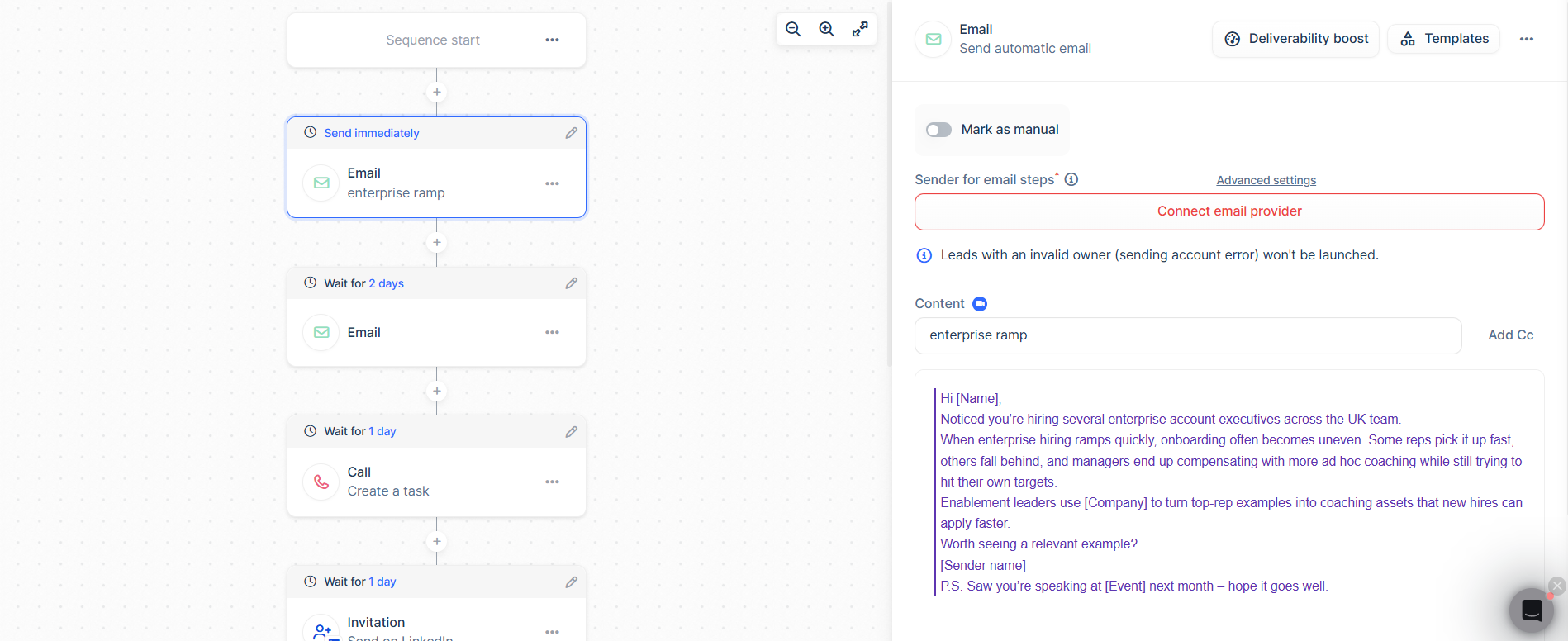
Subject: enterprise ramp
“Hi [Name],
Noticed you’re hiring several enterprise account executives across the UK team.
When enterprise hiring ramps quickly, onboarding often becomes uneven. Some reps pick it up fast, others fall behind, and managers end up compensating with more ad hoc coaching while still trying to hit their own targets.
Enablement leaders use [Company] to turn top-rep examples into coaching assets that new hires can apply faster.
Worth seeing a relevant example?
[Sender name]
P.S. Saw you’re speaking at [Event] next month – hope it goes well.”
This is not the only way to write the email, but the logic is clear:
- The observation is specific
- The problem belongs to the persona
- The solution keeps the buyer as the actor
- The ask is light
- The P.S. adds a small human detail
Now compare that with a weaker version:
“Hi [Name],
I saw your company is growing and wanted to reach out.
We help sales teams improve onboarding, coaching, and productivity through our platform.
Do you have 30 minutes next week for a demo?”
The second version is just too generic and too much about you.
It could go to hundreds of companies with almost no change. As a result, the follow-up emails, calls, and LinkedIn messages have very little useful context to carry forward.
The stronger version gives the whole cadence something to work with.
The call can reference enterprise hiring, the voicemail can point back to the email about enterprise ramp, the LinkedIn message can continue the same thread, and the follow-up can add a proof point or simplify the original problem.
Once again, this is why the first touch is not just the first step; it’s the narrative anchor for the entire cadence.
To show you what this might look like in practice, I actually built a multichannel outreach sequence in lemlist (in my opinion, one of the best multichannel outreach platforms in the market).
Extend the first touch across the cadence
It should be clear by now that the best way to approach cadences that start with a manual touch is to carry the foundational observation and hypothesis forward through the rest of the cadence.
What’s very common to see is that the first email is thoughtful, specific, and well-structured. But the follow-up then turns into something generic like: “Just following up on my previous note.”
Or the call introduces a different angle. Or the LinkedIn message feels disconnected from the email.
At that point, the cadence stops feeling like one coherent motion and becomes a collection of attempts.
That’s not what you want.
A strong cadence should keep the same thread alive across different touches and channels. Each step should at least reinforce the original hypothesis and/or add one useful piece of context or value.
Over time, it should become easier for the buyer to notice, understand, and respond to your outreach.
And even if the original hypothesis turns out to be wrong, that is not necessarily a problem. Buyers will often correct you, clarify the situation, or add context themselves, which still gives you a valuable opportunity to learn more about what is actually happening inside the account.
Follow-up emails: add something, don’t just remind
Follow-up emails should usually be shorter than the first email.
The first message carries the fuller structure: observation, problem, solution, and engagement. The follow-up does not need to rebuild all of that from scratch.
Instead, it should move the idea forward.
A useful follow-up can:
- add one extra piece of context,
- simplify the original problem,
- offer a relevant proof point,
- ask a lighter question,
- or start a new thread if the original one has gone stale.
For example, if your first email was about enterprise hiring and onboarding pressure, a weak follow-up would be: “Hi [Name], just following up on my previous email. Would love to find time to connect.”
That does not add much.
A stronger follow-up might say:
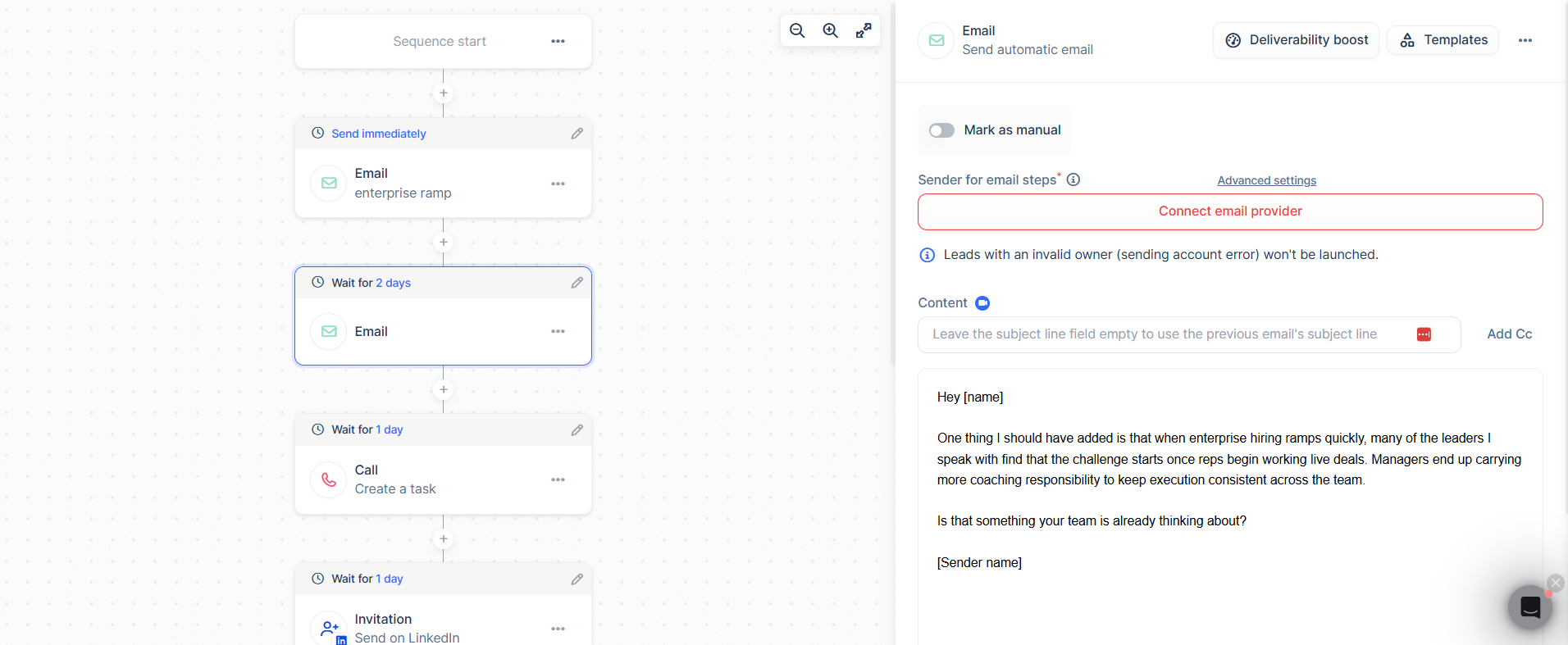
“One thing I should have added is that when enterprise hiring ramps quickly, many of the leaders I speak with find that the challenge starts once reps begin working live deals. Managers end up carrying more coaching responsibility to keep execution consistent across the team. Is that something your team is already thinking about?”
This works better because it adds a new layer while staying in the same narrative and making the original point more useful.
Here’s my example:
Calls: use the first observation as the anchor
The call should not feel like a completely separate pitch.
If the first email was strong, use it.
The observation from that email gives you a natural way to open the call and avoid sounding like you are calling from a script.
For example:
“Hi [Name], it’s [Your Name] from [Company]. I sent you a note earlier because I noticed you’re hiring several enterprise account executives across the UK team. The reason I reached out is that when hiring ramps quickly, onboarding and early pipeline creation can become uneven. I was curious whether that’s something you’re already seeing, or whether it’s too early.”
This is much stronger than: “Hi [Name], we help sales teams improve productivity. Do you have 30 seconds?”
The first version connects the call to the email, the account context, and a specific problem hypothesis. The seller sounds prepared, not random.
Calls create speed and directness, but they work best when they have a clear point of entry. The first touch gives you that entry.
This is the call in my lemlist sequence (notice how I added the script in the notes so it’s always handy):
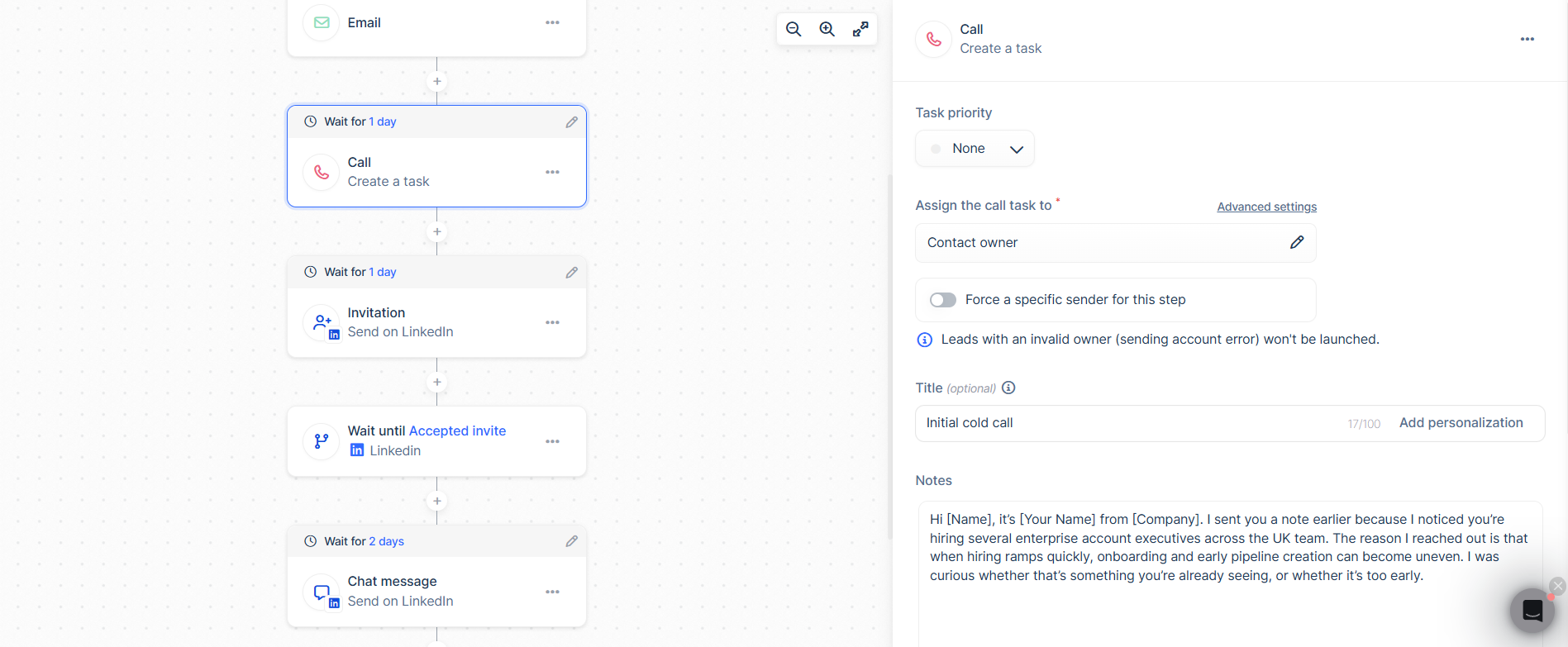
To give you a better idea of what is possible, I also made a conditional step where, if the call connected and the response was positive, it triggers a manual task to review the call and establish the next steps:

LinkedIn: continue the thread lightly
LinkedIn should not become a second inbox where you paste the same email. You want to keep things lighter there.
It should be leveraged to build familiarity, add context, and create a lower-friction way for the buyer to recognise you.
If you are not connected yet, the first step is to send a simple connection request.
If you are connected, you can reference the same thread naturally.
Avoid this: “Just bumping this here as well.”
Don’t be lazy.
A better version would be:
“Hi [Name], I sent you a note last week about enterprise hiring and the onboarding pressure that can come with it. Curious if that’s something your team is actively thinking about?”
Or, even lighter:
“Saw the enterprise hiring push and sent you a short note on something I’ve seen come up in similar teams. Thought it might be relevant.”
The key is to keep it contextual rather than pushy.
LinkedIn should help the prospect understand why your name keeps appearing. It should not make them feel like you are chasing them across every channel.
In my example sequence, I assumed that you are not yet connected with the lead (you will notice I didn’t include an invite note):

You may have also noticed that, for the next step (the LinkedIn message), I added the condition that the lead needs to accept the invitation before the message is sent:

Also, you will see that, once the lead accepts the LinkedIn connection request, I set lemlist to wait for two days before sending the actual message.
Voicemail: point back to the strongest message
Voicemail is often used wrongly (or not at all).
Many sellers leave a long pitch and ask for a call back.
In cold outbound, that is rarely the best use of the channel.
A better role for voicemail is to redirect attention back to the strongest message – usually the first email, or a follow-up with a useful proof point.
For example:
“Hi [Name], it’s [Your Name] from [Company]. I sent you a short note earlier about the enterprise hiring push and the onboarding pressure that can come with it. No need to call me back, but it should be easy to find under the subject line ‘enterprise ramp’. Thought it might be relevant.”
This works because the voicemail does not try to carry the whole pitch and instead adds a human voice, reinforces the context, and makes the email easier to find.
The thread matters more than the touch
The main idea in this whole section we covered is that you should not design each step of the cadence in isolation.
Once the first touch is clear, the rest of the cadence should align to questions like:
- How do we reinforce this idea?
- What extra context would make it easier to understand?
- Which channel gives this touch the best chance of being noticed?
- Are we adding value, or just asking again?
If every step only asks for time, the cadence starts to feel repetitive. But if each touch adds a little more clarity, context, or relevance, the motion feels more considered.
This is how you make a cadence become a coherent thread, carried across multiple channels, that is far more likely to convert leads into prospects.

Write automated emails that don’t pretend to be manual
So far, we’ve focused mostly on cadences that start with a manual touch.
That makes sense for High personalisation cadences, and often for Low personalisation cadences too. The first email creates the core observation and hypothesis, and the rest of the cadence can build from there.
But not every sequence starts with manual writing.
In Zero personalisation cadences, automated emails carry more of the motion, and it’s important that you are clear on what those emails are meant to do.
Automated emails should not pretend to be deeply bespoke.
If you try to do that, you’ll quickly get into trouble.
Avoid fake personalisation, shallow account references, or AI-generated lines that sound specific but don’t say anything useful. The email may look customised, but I can tell you that the buyer will feel that no real judgement went into it.
Automated emails should be short, clear, persona-specific, tied to a recognisable problem, easy to reply to, and light enough to feel human.
The main goal is not to make the buyer think you spent 20 minutes researching them personally; it is to make the message feel like it belongs in their world.
Relevance comes from segmentation
As we already briefly touched upon in earlier sections, in automated outreach, relevance comes from the work you do before the sequence is launched.
The work I am referring to lies with segmentation.
A good automated email should reflect some combination of:
- the persona you are speaking to,
- the segment they operate in,
- the vertical they belong to,
- the maturity level of the company,
- the use case you are leading with,
- and the business problem that tends to show up in that context.
This connects directly to the layered messaging model I use in my sales messaging guide: company narrative → segment → vertical → persona → channel/stage. The point is to translate the broad story into language that fits the specific buyer and interaction, instead of using one generic message everywhere.
For instance, an automated email to a RevOps leader in a mid-market software company should not sound the same as an automated email to a procurement leader in manufacturing.
Even if neither email contains account-specific research, both should feel different because the buyer’s world is different.
Keep each email focused on one idea
Automated emails often fail because they try to do too much.
They include a big opening claim, three problems, several benefits, a customer proof point, a product explanation, and a meeting ask.
Don’t approach things that way, as it will just create confusion and friction.
A stronger automated email stays centred on one core idea.
That idea may include one relevant problem, one useful perspective, one supporting proof point, and one simple question.
But all of them should reinforce the same underlying point.
For example:
“Hi [Name],
When RevOps teams support a fast-growing sales org, process consistency often becomes harder to maintain across managers, regions, and tools.
Teams usually try to solve this with more documentation, but the real challenge is making the process visible in the moments where reps actually work.
Is that something your team is trying to improve this year?”
That email is not deeply personalised, but it is still specific enough to feel relevant to a RevOps audience.
It speaks to their world, uses plain language, and asks a simple question.
Don’t make automated emails look overproduced
Automated emails should usually feel like emails, not brochures, so be careful with things like heavy formatting, too many links, long paragraphs, multiple calls to action, large images, excessive bolding, and polished marketing language.
The more an email looks like a campaign, the easier it is for the buyer to ignore it.
A simple, plain-text email often works better because it feels closer to a real seller-to-buyer message.
Use automated emails to support the cadence, not carry everything
Automated emails are useful because they help you maintain coverage, test messaging across segments, and avoid relying entirely on seller memory.
But they should not carry the full burden of the cadence.
Calls, LinkedIn, voicemail, and manual interventions are still critical, especially when engagement appears.
A simple rule to keep in mind is: automate the structure while humanising the moments that matter.
If a prospect replies, visits a high-intent page, accepts a connection request, or another stakeholder from the account engages, the motion should change.
At that point, the seller should step in.
The automated sequence has done its job by creating coverage and surfacing interest. Now the next touch needs judgement.
What good automated emails should do
A useful automated email should:
- feel relevant because the segmentation is strong,
- focus on one clear idea,
- sound like something a person would actually write,
- avoid pretending to be more personalised than it is,
- and make it easy for the buyer to respond.
That’s it.
Automated emails do not need to be clever. They need to be clear, useful, and properly aimed.

Deliverability and sequence hygiene
Since email often acts as the anchor channel in a multichannel cadence, deliverability matters a lot.
With the rise of automation, sales engagement tools, and increasingly crowded inboxes, deliverability has become a much bigger topic than it used to be. Email providers are constantly updating how they evaluate sending behaviour, which means even strong messaging can struggle if the underlying setup and sequence hygiene are weak.
I sometimes joke that you now need a degree in deliverability just to navigate it properly.
I’m not going to turn this section into a full deliverability guide as there are already excellent resources dedicated entirely to that topic. But I do want to cover a few practical fundamentals that tend to make the biggest difference in outbound, many of which I’ve learnt from experts who specialise deeply in cold email and deliverability, like Yurii Veremchuk and others in the space.
Set up the basics properly
At a minimum, make sure your sending setup is properly authenticated.
That usually means configuring:
- SPF – to show which servers are allowed to send email from your domain
- DKIM – to add a digital signature to your emails
- DMARC – to tell receiving servers how to handle messages that fail authentication
These records help mailbox providers trust that your emails are legitimate. Without them, even good messaging can struggle to reach the inbox.
If you use a platform like lemlist, it can guide you through parts of this setup and help verify whether key records are configured correctly.
Keep sending volume consistent
Cold outbound suffers when sending behaviour looks erratic.
If a mailbox sends almost nothing for weeks, then suddenly pushes hundreds of emails in a day, that can create risk.
A healthier approach is to keep volume predictable by:
- warming up new mailboxes before using them heavily,
- increasing volume gradually,
- avoiding sudden spikes,
- distributing volume across mailboxes where appropriate,
- and monitoring performance as volume grows.
Many tools can support this through sending limits, warm-up workflows, and deliverability monitoring. lemlist, for example, includes lemwarm and a Deliverability Hub designed to monitor deliverability signals across warm-up and outreach activity.
But the tool still needs sensible rules behind it.
If your data is poor, your targeting is loose, or your sequence is too aggressive, the platform can only do so much.
Keep emails light
The way an email is written and formatted is also very important.
In cold outreach, simple usually wins.
As we already mentioned before, avoid overloading emails with:
- too many links,
- heavy images,
- large signatures,
- multiple calls to action,
- embedded videos,
- buttons,
- link shorteners,
- and dense formatting.
This is partly a deliverability issue and partly a buyer-experience issue.
Once again, the more an email looks like a marketing campaign, the easier it is to ignore. The more it feels like a clear, plain message from one person to another, the better chance it has of being read and answered.
A practical rule: make the email easy to read even if every image, link, and formatting element were removed.
Avoid spam-heavy language
Mailbox providers and buyers both react badly to language that feels exaggerated.
You don’t need to obsess over every word, but you should avoid phrases that make the email feel like a mass campaign.
Be careful with language like:
- “guaranteed”
- “risk-free”
- “limited time”
- “double your revenue”
- “revolutionary”
- “act now”
- “free!!!”
- “no obligation”
- “exclusive offer”
The issue is not only filtering. It’s also credibility.
Plain language tends to perform better because it sounds like a person wrote it.
Use clean data
Beyond the email setup itself, data quality sits at the centre of many deliverability problems.
Even if your technical setup is excellent, poor contact data will still create issues. Bounce rates go up, mailbox reputation weakens, and over time even strong emails can start landing in spam or promotions folders.
That’s why sequence hygiene starts with list hygiene.
Before launching a cadence, make sure you:
- verify email addresses where possible,
- remove obvious bad data,
- avoid generic inboxes unless there is a clear reason,
- remove contacts who have changed roles,
- remove people who opted out,
- and avoid repeatedly emailing contacts who never should have been in the sequence.
I know this is not exciting work, but it protects the system.
Segment sequences properly
Earlier in the article, we discussed how segmentation improves relevance in automated emails.
But segmentation is not only a messaging principle. It also supports deliverability indirectly.
When sequences are well targeted, they are more likely to generate positive engagement: replies, meetings, clicks where appropriate, or at the very least fewer complaints and deletes.
Poorly segmented outreach does the opposite. It creats low response, low relevance, more deletes, more spam complaints, and more negative signals over time.
So, if you want stronger deliverability, don’t only think about DNS records and mailbox setup.
Think about whether the right people are receiving the right message in the first place.
Refresh messaging regularly
Even strong sequences need regular updating.
The market changes, buyers see similar language more often, competitors copy messages, your own list quality changes, and so, what worked three months ago may start to lose effectiveness.
That’s why cadence hygiene should include a regular review of metrics like reply rates, positive reply rates, bounce rates, spam complaints, unsubscribes, meeting conversion, and where people drop off in the sequence.
But this should not stop at performance monitoring alone.
The best outbound teams use this data to continuously refine the motion itself.
That may include:
- testing different subject lines,
- experimenting with different opening observations,
- adjusting problem framing by persona,
- simplifying calls to action,
- testing sequence length,
- changing channel order,
- or refining the timing between touches.
Over time, this creates a much stronger understanding of what actually resonates with different buyers and segments
If you have a more mature outbound setup, this process should become increasingly experimental.
You should consistently A/B test messaging, compare angles, and use real engagement data to learn faster rather than relying only on instinct or anecdotal feedback.
That’s how many of the strongest outbound organisations operate. They treat outbound as a system that improves through iteration, not as a static sequence that gets written once and left untouched for six months.
You do not need to rewrite everything every week, but you should avoid letting sequences run unchanged while performance quietly declines.
For most active outbound motions, I’d say that a monthly review cadence is a sensible baseline.
Make opt-out easy
People should have a clear way to stop receiving emails.
That’s good practice, and in many jurisdictions it is also a compliance issue.
Beyond the legal angle, it protects the buyer experience and your sending health.
If someone is not interested, you want a clean opt-out rather than a spam complaint.
A simple line can work: “If this is not relevant, let me know and I won’t follow up.”
For more automated campaigns, use the appropriate unsubscribe mechanism based on your market, tools, and compliance requirements.

Cold calling inside a multichannel cadence
Cold calling deserves its own section because the phone plays a very specific role inside a multichannel cadence.
Calling gives you something email and LinkedIn rarely give you, which is a real-time reaction.
A good call can help you test whether your observation is relevant, hear how the prospect describes the problem, uncover whether you are speaking to the right person, and move faster when there is genuine interest.
This is why I believe cold calling remains a critical component of modern outbound. As I covered in my cold calling training guide, a well-executed call remains one of the most direct ways to reach a prospect, and, at a professional level, for a seller, it builds skills that carry across the rest of the sales process.
However, what’s important to highlight is that inside a cadence, the call should not start from zero.
If you’ve already sent a relevant first email, use it.
The call should pick up the same thread: “I noticed this. I had a thought about what it might mean. I’m curious whether that’s actually relevant.”
Such an approach gives you a reason to call that feels connected to the rest of the motion and helps the seller sound prepared rather than random.
Start with context rather than a generic pitch
A weak cadence call often sounds like this: “Hi [Name], it’s [Your Name] from [Company]. We help sales teams improve productivity. Do you have 30 seconds?”
That may get you into the call, but it does not give the buyer much reason to stay.
A stronger opener uses the observation from the cadence: “Hi [Name], it’s [Your Name] from [Company]. I sent you a note earlier because I noticed you’re hiring several enterprise account executives across the UK team.”
With that opener, you are clearly stating why you are calling and you are connecting to something specific.
Then you can move into the hypothesis: “The reason I reached out is that when enterprise hiring ramps quickly, onboarding and early pipeline creation can become uneven. I was curious whether that’s something you’re already seeing, or whether it’s too early.”
Ultimately, you are not trying to force the full pitch into the first 20 seconds. You are testing whether the problem has any weight.
Use structure, but don’t sound scripted
We all know that cold calls are highly unpredictable.
You do not know whether the person will answer, how much time they have, what mood they are in, or whether they will object before you even finish your first sentence.
It is that for that reason that I believe maintaining some level of structure in your cold calls is critical.
When I say “structure”, I don’t mean reading from a rigid word-for-word script. I mean having a clear flow for the most important parts of the conversation and a few key points you want to communicate throughout the call.
Many people assume structure makes sellers sound robotic, but I think the opposite is true.
Good structure gives the seller a roadmap when the conversation becomes unpredictable. Even experienced callers need a clear flow because, without one, they are simply improvising under pressure.
For cadence calls, I’d keep the structure simple:
- Open with context – Reference the email, observation, or account signal.
- Pause – Give the buyer a second to place you.
- Check familiarity – “Did that ring a bell?” or “Did you happen to see it?”
- Ask permission – “Mind if I give you the short version?”
- Simplify the hypothesis – Connect the observation to one likely problem.
- Ask an open question – Give them room to correct, confirm, or redirect.
That might sound like this:
“Hi [Name], it’s [Your Name] from [Company]. I sent you a short note earlier about the enterprise hiring push across the UK team.
Did that ring a bell?
Mind if I give you the 20-second version of why I reached out?
I noticed the hiring because when teams add enterprise sellers quickly, the challenge often shifts from hiring to getting consistent early pipeline creation across the new team.
Is that something your managers are already dealing with, or is it still too early?”
The structure gives the seller control, but the language still sounds like a person.
If you’d like to go deeper into a more structured and practical approach to cold calling, I’d recommend checking out my cold calling script template. It’s based on my experience training thousands of sellers and shaped by many of the principles used by some of the strongest sales practitioners in the space.
Use the call to learn, not only to book
Of course, the ideal outcome of a call is a booked meeting.
But if that is the only thing you care about, you miss a lot of value and will probably perform worse over time because your focus becomes tied too heavily to an outcome that is not fully within your control.
A call can also tell you:
- whether your hypothesis is right,
- whether the timing is wrong,
- whether another stakeholder owns the problem,
- whether the company already has an initiative in flight,
- whether the pain is stronger or weaker than you thought,
- or whether your messaging needs to change.
That kind of information should feed the rest of the cadence.
If the buyer says, “This is actually more of a RevOps issue here,” your next touch should not continue as if nothing happened.
If they say, “We’re not hiring enterprise reps until next quarter,” your follow-up should reflect that.
The phone gives you live market feedback. Use it.
Handle resistance by understanding it first
I am not going to provide you with a full objection-handling system in this article. I cover that in much more depth in the cold calling training guide, including the difference between reflex objections and real objections.
Reflex objections are quick brush-offs like “I’m busy” or “just send me an email”, while real objections point to genuine constraints such as budget, timing, or an existing provider.
For this guide, the main point I want to leave you with is to not treat every objection as something to defeat.
First, understand what kind of resistance you are hearing.
If someone says, “Can you just send me something?”, it’s very likely it may simply be a reflex response.
You could answer: “Of course. I sent a short note earlier about the enterprise hiring push. Before I resend it, can I ask one quick thing? Is onboarding consistency actually a priority right now, or am I off base?”
That way, you keep the conversation open without sounding pushy.
If someone gives a slightly more substantive objection, such as “We already have a programme for this”, it may still be partly reflexive, but there is also a reasonable chance it reflects something real.
Instead of immediately pushing back, try to understand what actually sits underneath it.
For example: “That makes sense. Is the programme mainly focused on onboarding content, or does it also cover how managers reinforce execution once reps start working live deals?”
Or, more openly: “Makes sense. Out of curiosity, what does the current programme mainly focus on today?”
You are not arguing; you are openly learning.
Big difference.

LinkedIn inside a multichannel cadence
As we already mentioned in previous sections, LinkedIn plays a different role from email and phone.
We could say that email carries the clearest written hypothesis, phone tests and accelerates, and LinkedIn builds familiarity.
I notice very often how LinkedIn is often misused inside outbound cadences.
Some sellers treat it like another inbox. They paste a cold email into a direct message, send a connection request with a pitch attached, and then follow up with something like: “Just bumping this here too.”
Honestly, that usually does more harm than good.
LinkedIn should feel lighter than email. It should help the buyer recognise your name, see your context, and connect your outreach to the same underlying idea without feeling chased across channels.
Start with the connection request
In many cases, the simplest move is to send a connection request without a note.
This may sound counterintuitive, because sellers are often told to personalise every touch. But there is a practical reason for keeping the connection request clean.
A generic note can make the request feel like the start of a pitch. A personalised note can take time to write and still may not improve acceptance enough to justify the effort.
Needless to say, there will always be exceptions.
If you have a strong mutual connection, a previous relationship, or a genuine reason to add context, you can use the note. But for standard cadence execution, I would usually keep the request simple and let the rest of the motion create the context.
Do not message the second they accept
If someone accepts your connection request, resist the urge to message them immediately.
It can feel too automated.
A better approach is to let the connection sit for a moment, then message when it naturally aligns with the sequence. For example, after you have sent the first email, made a call attempt, or shared a useful follow-up.
If they do not accept, move on
Not everyone will accept your request, and that’s fine.
If they don’t accept, don’t force the channel.
You can still call, email, leave a voicemail, or engage lightly with visible content where appropriate. But sending long InMails or Sales Navigator messages to someone who has not accepted often adds effort without much return.
In a cadence, every touch should earn its place.
If LinkedIn is not open as a direct channel, use it for context and familiarity instead of forcing a conversation.
That might mean:
- checking their profile for useful context,
- looking at recent posts or comments,
- noticing shared connections,
- identifying role changes,
- understanding how they describe their priorities,
- or engaging with content if there is a real reason to do so.
The goal is still to improve the quality of the motion, not to create more noise.
When you do send a DM, keep it casual and cadence-congruent
If they accept your request, and you decide to send a direct message, keep it short.
The DM should usually do one of three things:
- reference the same observation from the cadence,
- ask a light, open-ended question,
- or point back to a useful email without sounding like you are chasing them.
For example, avoid this: “Hi [Name], I wanted to follow up on my email and see if you had any availability for a quick demo next week.”
That feels like email, just moved to LinkedIn. Plus, it’s too directly agenda-driven.
A better version might be: “Hi [Name], saw the enterprise hiring push and sent you a short email note on something I’ve seen come up in similar teams. Curious if onboarding consistency is already on your radar?”
Or, if you want to point back to the email: “Hi [Name], I sent you a note last week about enterprise hiring and the onboarding pressure that can come with it. Curious if that’s something your team is actively thinking about?”
Those work better because they are short, contextual, and connected to the same thread. It gives them a reason to understand why you are there.
Use LinkedIn to start small conversations
LinkedIn can also help you create small moments of interaction before asking for time.
Many sellers miss the point that not every LinkedIn message needs to ask for a meeting. Sometimes the better move is to ask a lighter question that helps you learn whether the topic matters.
For example: “Saw your team is expanding the enterprise function. Are you expecting that to change how managers support ramp this quarter?”
Or: “Noticed you’ve been posting about manager effectiveness recently. Is that becoming a bigger focus for the team this year?”
The key principle here is to start with context, then ask something easy to answer.
If they reply, you can develop the conversation. If they do not, you have still reinforced the same thread without overreaching.
Use content to increase familiarity over time
There is another layer to LinkedIn that sits outside the individual cadence but still improves it: content.
If you post useful content regularly, some prospects will start seeing your name before they ever receive an email, call, or DM from you, and that can make later outreach feel less cold.
I am not suggesting that every seller needs to become a content creator here, but it’s undeniable that social presence can support outbound.
At a basic level, sellers can:
- keep their profile clear and credible,
- engage thoughtfully with posts from contacts within target accounts,
- share occasional useful views on customer problems (even just 1-2 times per week),
- and avoid turning every interaction into a pitch.
When those actions are done well, buyers are more likely to respond because you’ll be perceived as someone who feels familiar, credible, or contextually relevant.

Voicemail inside a multichannel cadence
Voicemail is one of those channels people love to debate.
Some sellers swear by it. Others say nobody checks voicemail anymore, so there is no point leaving one.
I think the truth sits somewhere in the middle.
You probably should not expect many prospects to call you back because of a voicemail and I think that is rarely the best measure of whether voicemail is useful.
I see a voicemail as something that can add a human voice to the cadence, reinforce the same context you have already introduced, and direct the buyer back to the strongest written message.
The aim is not: “Please call me back.” It is closer to: “I sent you something relevant. Here’s why it may be worth finding.”
If your first email was strong, the voicemail should point back to it. If the observation in your email was relevant, use that same observation as the hook.
For example:
“Hi [Name], it’s [Your Name] from [Company].
I sent you a short note earlier about the enterprise hiring push across the UK team and the onboarding pressure that can come with it.
No need to call me back, but it should be easy to find under the subject line ‘enterprise ramp’.
Thought it might be relevant. Have a good day.”
You do not need to leave a long pitch. You do not need to explain your product. You do not need to repeat the whole email verbally.
In fact, the longer the voicemail becomes, the more likely it is to lose the point.
A good cadence voicemail should usually:
- reference the same observation or hypothesis,
- point back to the email or strongest message,
- mention the subject line if useful,
- remove pressure to call back,
- and stay brief.
The “no need to call me back” line may feel counterintuitive, but it can work because it lowers pressure.
You are not asking them to stop what they are doing and return a cold call. You are simply making the email easier to find and giving them a reason to read it.
Voicemail also adds something subtle that email cannot which is putting a real voice behind your name.
That can make later emails or LinkedIn touches feel slightly more familiar. Even if the prospect does not respond directly to the voicemail, they may recognise your name later and give the next email a bit more attention.
So, I would keep voicemail simple.
Use it when you call. Keep it short. Reference the thread. Point back to the strongest message.

Conclusion
Multichannel outreach does not work because you add more channels; it works when those channels create one coherent buying experience.
That is the central idea I want you to take away from this guide.
Email, phone, LinkedIn, voicemail, SMS, and any other channel you use should work together around the same narrative thread.
But before you action a cadence, a few other foundational elements need to be in place.
You need to know which accounts deserve your effort, which stakeholders matter most, whether there is a better way to open the conversation, and what level of personalisation is justified.
Then, when a cadence is the right route, you need to design it with intent.
The first strong touch matters because it gives the rest of the motion something to build from. A clear observation, a relevant problem, a buyer-centred solution, and a low-friction ask can become the anchor for your follow-up emails, calls, LinkedIn messages, and voicemails.
The best outbound teams treat cadence design as a system.
They decide where manual effort is worth it. They use automation where coverage matters. They let tiering set the baseline, signals adjust the exception, and data improve the motion over time.
Modern outbound requires a high level of discipline to work, and I hope this guide has given you some practical ways to think about outbound differently and build cadences that feel more connected, relevant, and effective.


