

Disclaimer: The views and opinions expressed in this article are those of the individual contributors and do not reflect the official policy or position of their current or previous employers. This content is for informational purposes only.
Introduction
Everyone working in sales enablement for more than a few years has undoubtedly noticed a significant surge in interest and a steady influx of talent into roles within the field.
As a discipline that perfectly marries strategic thinking with practical, hands-on sales tactics, it appeals to a wide range of professionals seeking a career that continuously evolves and challenges.
The role’s multifaceted nature has made it an attractive option for individuals from various backgrounds, be it sales, marketing, product, customer success, or human resources.
With more professionals entering the field, they bring diverse perspectives and skills, further enriching the discipline.
The future of sales enablement looks promising, and it’s a thrilling time to be a part of this growing community.
The only common thing that people with a career in sales enablement share is that their paths have been different.
This is why I wanted to talk to a number of sales enablement professionals and find out what their enablement career paths have been like and what attracted them to the field.
In addition to their invaluable perspectives, this article will try to help you figure out whether you truly wish to make the jump and what you can do to make your sales enablement career path easier.
The growing popularity of sales enablement
When I say that sales enablement is a growing community, I’m not joking. Regardless of your vantage point, it’s obvious that the discipline is experiencing significant growth.
The numbers
According to Miller Heiman Group, in 2013, only 19% of companies had a dedicated sales enablement function. This percentage surged to 61% in 2019.
The Sales Enablement Pro 2020 State of Sales Enablement Report showed an increase of 343% in the adoption of sales enablement over a five-year period.
Moreover, a report by Grand View Research showed that the global sales enablement software market, valued at “only” USD 3.6 billion in 2021, is expected to grow to USD 12.78 billion in 2030.
The job boards tell a similar story, with 9,000 sales enablement-related job postings on LinkedIn.
Even when you look at something as simple as the monthly number of people Googling the term sales enablement, it’s obvious sales enablement is only gathering steam.

In December 2015, only 710 people searched for “sales enablement” on Google. In April 2023 (the last available data point), this number was 6,891.
The reasons
The list of reasons for the growing adoption of sales enablement is a long and varied one:
Business results: It all starts with results. If sales enablement didn’t show tangible, measurable results, it would have long been dismissed as a mere buzzword.
In my 2025 Handbook – “What is Sales Enablement?”, I quote a number of studies showing that implementing sales enablement within sales organisations leads to increased sales and win rates, surpassing revenue goals, and increased efficacy of sales training.
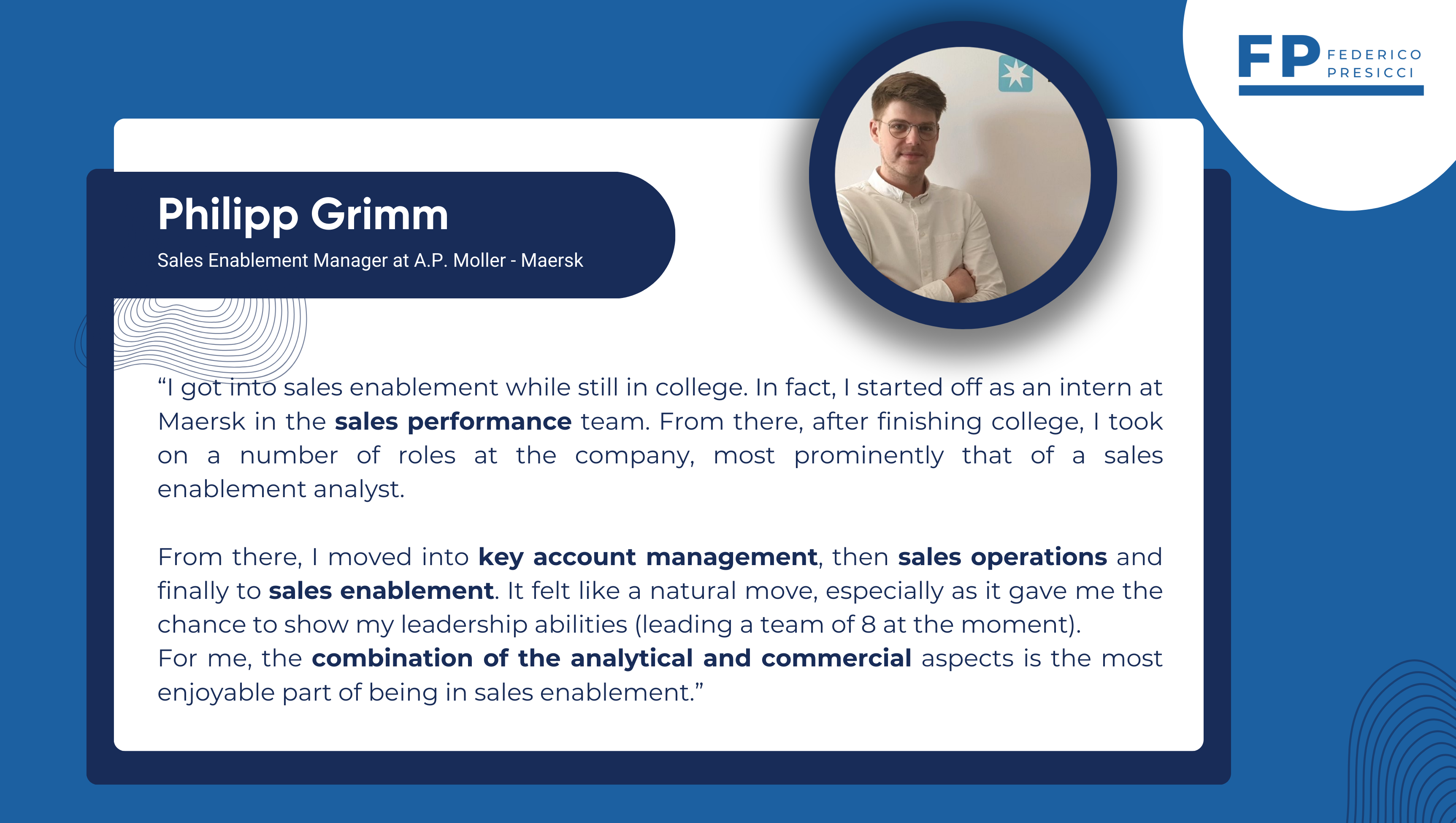
For some people, this combination of analytical and commercial aspects of sales enablement played a crucial role in deciding to enter the field, like Philipp Grimm, a Sales Enablement Manager at A.P. Moller-Maersk.

Increasingly complex and lengthy sales cycles: Sales cycles are becoming increasingly complex and lengthy with each passing week, particularly in B2B environments.
Sales enablement plays a crucial role in navigating these intricate sales processes. It equips sales professionals with applicable knowledge and skills, just-in-time content, and effective sales strategies.
More complex products: The increasing complexity of products, especially in sectors like technology, healthcare, and finance, demands a sophisticated understanding of product features, benefits, and applications.
Sales enablement addresses this need by providing comprehensive product training and resources.This ensures that sales teams are not only knowledgeable about the products they are selling but also adept at articulating their value to diverse customers with varying needs.
Increased number of stakeholders: The decision-making process often involves multiple stakeholders in the modern sales scenario, especially in B2B transactions.
This trend towards collective decision-making increases the complexity of sales engagements.A sales enablement strategy is crucial in this context, as it helps sales teams understand and address the unique concerns and priorities of each stakeholder.
Sales enablement evolution: One of the most exciting aspects of sales enablement is that it’s still a relatively nascent field.
With the influx of fresh ideas and diverse viewpoints, sales enablement is never boring. As new challenges emerge and customer expectations shift, sales enablement professionals are at the forefront of adapting and innovating.
The sales noise: New technology enables even the smallest sales teams to inundate leads with copious amounts of sales messaging.
As a result, potential customers are exposed to an unprecedented level of sales noise.Sales enablement ensures that your organisation’s sales team is empowered to cut through the noise and actually get their message heard.
In summary, if you don’t know much about the future of sales enablement, all you need to remember is that it’s a discipline that is here to stay and poised to become even more widespread as sales processes and the technological landscape become more complex.
Different types of sales enablement jobs
One “side effect” of it being a relatively new discipline is that sales enablement jobs may not be as clearly defined as in other fields; let alone the responsibilities that would be included in the job description.
For instance, a sales enablement manager or director at a small-to-medium company could easily find themselves doing everything – from establishing a sales enablement strategy to coaching sales reps, fine-tuning sales reporting, or even developing sales enablement content.
On the other hand, a large company with an established sales enablement function will probably feature a well-defined enablement team with specialised positions such as sales training specialists, sales content specialists, sales performance analysts, instructional designers, and programme managers.
The image below presents a list of the most common, somewhat common, and least common sales enablement jobs that can be found in the market.
They include the director of sales enablement, sales enablement manager, sales enablement specialist, sales enablement consultant, sales trainer, sales content manager, sales enablement analyst, instructional designer, sales coach, sales enablement coordinator, and sales enablement program manager.

While this may seem like a confusing situation that only complicates your entry into the field, it can actually make it easier.
Namely, the variety of roles that can be found in sales enablement makes it possible for people with very different backgrounds and sets of skills to kick off their sales enablement career.
How do I get into sales enablement?
Hopefully, the question currently on your lips is how one actually gets into sales enablement.
Put simply, the answer will depend on your particular set of skills, personal affinities, experience, and the field you have spent most of your time in.
From sales to sales enablement
The majority of sales enablement professionals come from the world of sales, which is perfectly understandable.
Their background, their skills, and their experiences make them most likely to have a natural-feeling transition into the field.
My story
I may be unconsciously biased, but my personal experience has felt truly organic, and in my interactions with other sales professionals who moved into sales enablement, I heard innumerable stories similar to mine.
In any case, it’s a good illustration of how a salesperson can almost seamlessly transition to sales enablement.
Typically, a sales team, any sales team, features a top performer – someone who hits and exceeds their quota on a regular basis.
Soon enough, they either take it upon themselves or are encouraged by their management to provide advice or support to their teammates.
Depending on the company and the sales organisation within the company, what starts as informal knowledge-sharing can soon become a more formal process that doesn’t only entail training or coaching sessions led by the salesperson but also involves a more comprehensive sales enablement framework.
In my particular case, the company I was working for decided to bring in a seasoned sales enablement leader to support our rapid growth.
Since I was (at that point) the only salesperson with training and coaching experience, this new VP of Sales Enablement saw me as the logical first addition to his team.
It didn’t take me long to realise that I enjoyed this new direction my career was starting to take, and, thanks to my manager’s expertise, my dedication to the craft, as well as my proclivity to coaching others, a very clear sales enablement career path started appearing before me.
A few caveats
Transitioning into sales enablement felt like a natural progression for me, yet it’s important to acknowledge that not all top salespeople aspire to move into this field.
Many are deterred by the potential reduction in earnings. Top sales roles, with their commissions and bonuses, often outpace the financial rewards of sales enablement positions.
On the other hand, there are salespeople who value the work-life balance that is usually better in sales enablement than in traditional sales.
This is something that Martina Stella, a Sales Enablement Manager at Elsevier shared with me, for example.

Moreover, the shift from being in direct control of one’s success as a salesperson to having your success rely on the achievements of others can be a challenging adjustment.
Sales enablement demands a measure of comfort with this indirect influence, coupled with a natural inclination towards collaborative work and an affinity to understand sales strategy.
Also, transitioning into sales enablement independently is another viable path for salespeople, particularly in growing organisations where there’s an emerging internal need for dedicated roles in sales training and coaching.
This is exactly what happened to Adilia Gutiérrez Padilla, now a Senior Sales Enablement Specialist at Mangopay.
Her first sales enablement job was the result of filling a gap that was created due to an official sales enablement position being removed from the organisation.
She had to wrap her mind around everything and then do it.

While this route may lack the direct mentorship of an experienced professional, which I had in my case, it remains a feasible option for those committed to learning and growth.
As we can learn from Jorge Quirce, the Manager for Global Sales Enablement at Salesforce, at times, you may find yourself in a sales enablement position by accident.

Finally, it has to be said that the most effective sales enablement professionals aren’t necessarily those who are top sales performers.
A diverse set of traits and skills can often be more conducive to success in sales enablement, underscoring the fact that excelling in sales doesn’t automatically translate to proficiency in enablement roles.
A great example of this diverse set of skills is Marika Kalusa-Günther, a Sales Enablement Project Manager at Deutsche Telekom.

Sales enablement career for non-sales people?
As I mentioned earlier, sales enablement is not an exclusive club reserved solely for people coming from sales.
Due to its collaborative nature, many people from marketing teams, customer success, professionals from revenue or product teams, and professional managers find their place in sales enablement and thrive in the field.
For the majority of marketers, the entry point into sales enablement is usually through sales enablement content – one of the pillars of sales enablement.
At the very core of every marketer’s work is their ability to engage, persuade, and nurture prospective customers.
This is exactly what sales enablement content is supposed to do.
The biggest difference is that sales enablement assets present higher sales applicability (ease of use for the seller) compared to traditional marketing content.
The best enablement adoptions almost invariably involve an advanced integration of marketing and sales.
It’s only natural that some marketers start specialising in sales enablement content. Some decide to go further, expand their horizons, and become full-fledged sales enablement professionals.
Like Nina Matejčić, a Sales Enablement Program Lead at Wrike did.

Customer success professionals are also uniquely poised to transition into sales enablement.
One of the main goals of sales enablement is to elevate the buyers’ experience, and who knows buyers better than the people who interact with them the most?
On top of knowing the customers, customer success professionals also know the product better than anyone else.
Their livelihood depends on understanding the customer-product interaction and its many nuances.
It should come as no surprise that people with customer success backgrounds often bring unique insights once they move into sales enablement.
Sometimes, people from human resources also discover that their background in onboarding and helping people find their way at a new company makes for a good foundation for a new career in enablement.
Sabrina Merchant, a Senior Sales Enablement Specialist, is a great example. She actually left a recruiting job at LinkedIn to try her hand at enablement.
She hasn’t looked back since.

Individuals with a background in product management possess a unique blend of skills that makes them well-suited for roles in sales enablement.
Their deep understanding of product functionalities and insights into market needs and customer perspectives equip them to bridge the gap between product development and market demand.
Maciej Rak, Global Sales Enablement Manager at Philips was kind enough to share his personal story and insights.

This experience is invaluable in sales enablement, where the key objective is to arm sales teams with the knowledge and resources needed to effectively and efficiently communicate the value of the product.
Moreover, product managers typically have a rich history of cross-functional collaboration, working closely with marketing, engineering, and sales teams.
This collaborative skill set is crucial for any successful sales enablement professional.
Managers or general programme managers also sometimes discover that sales enablement is the career path for them.
Their ability to see the sales function as part of a bigger mechanism can be of huge help to sales enablement.
The same goes for their ability to think strategically and long-term.
They are also adept at setting up and analysing systems and processes that will ensure the most effective functioning of the sales organisation.
Finally, they are very familiar with delegating and working through others, an often underestimated ability.
While I stand behind everything I wrote in this section, I’d feel remiss not to acknowledge the age-old debate on whether non-salespeople can succeed at enablement.
On the one hand, there will always be those who say that no sales team will fully trust and respect someone who hasn’t been in their shoes.
On the other hand, some of the biggest names in sales enablement put forward a lot of rock-solid arguments on why this is not the case, or at least why this is not an insurmountable obstacle.
Enablement expert and author Mike Kunkle wrote an excellent article on this topic, and there’s no denying that he showed up for the debate prepared.
What skills do I need to succeed in sales enablement?
Sales enablement is a complex discipline, and, as such, it demands a lot in terms of skills.
This is especially true for people who are looking to master every facet of the discipline and move into managerial or executive roles.
These sales enablement skills can roughly be divided into three categories: strategic, technical, and interpersonal.

Strategic skills
Strategic planning: Developing and implementing effective sales enablement strategies and aligning them with overall business goals.
Sales acumen: Understanding various sales processes and methodologies and what drives sales success.
Customer-centric mindset: Deep understanding of customer needs and buying processes, aligning sales strategies with customer expectations.
Change management: Managing change, particularly adapting sales strategies to evolving market conditions, and helping teams navigate change.
Problem-solving: Identifying challenges and bottlenecks in the sales process and general sales execution, and devising practical solutions, using creative thinking to overcome obstacles.
Project management: Managing multiple projects and priorities, with skills in planning, organising, and executing sales enablement initiatives.
Technical skills
Analytical thinking & data literacy: Analysing sales data, deriving actionable insights, and using data analysis tools and CRM software to report on the impact of sales enablement programmes.
Technology proficiency: Familiarity with the latest sales enablement tools and technologies, and integrating various digital tools to support sales.
Content development & management: Developing effective sales content using various tools and managing sales resources for easy access.
Learning design: Designing effective training programmes, taking into account adult learning and instructional design principles.
Interpersonal skills
Communication skills: Proficiency in clear, effective communication, both written and verbal, for creating materials, conducting training, and much more.
Training & coaching abilities: Skills in training delivery and holding individual and group coaching sessions with sales teams.
Emotional intelligence: Managing one’s own emotions, empathising with others, and building strong interpersonal relationships.
Collaboration & teamwork: Collaborating effectively with cross-functional teams and building relationships across departments.
Stakeholder management: Engaging with key individuals across the organisation to gain sponsorship and buy-in, align sales enablement initiatives with broader business goals, and manage expectations.
(Read more about stakeholder management best practices here.)
Leadership & mentorship: Leading and mentoring sales teams, motivating and inspiring them towards the achievement of their goals.
Adaptability & agility: The ability to pivot strategies and approaches as market conditions or organisational priorities evolve.
If this list feels overwhelming, you can rest assured that no one who goes into sales enablement possesses all those skills.
Most of them can be learned and honed over time and no one expects someone in an entry-level position to have all the skills of a seasoned sales enablement professional.
This is why the passion for helping and enabling others and the drive for self-improvement are the two key traits you MUST have to succeed in sales enablement.
They will push you to ask questions, identify the essential skills to develop, interact with and learn from everyone you collaborate with, discover new sales enablement ideas, identify the sales enablement best practices, and constantly find new ways to improve the enablement team and the sales organisation you are a part of.
Sarah Rosenbaum, a Senior Enablement Program Manager at Chargebee told me that it was exactly this passion she always had for helping others succeed that drove her to sales enablement.

The passion and the inner drive will keep you on the path of mastering many of the skills mentioned above.
If you are really lucky, you might even come across role-specific sales enablement training courses or communities that can be of huge help.
Of course, it also doesn’t hurt to prepare for the interviews that you will be having with your prospective employers. I’d recommend checking out my sales enablement interview tips that I collaborated on with 39 enablement leaders and managers.
Where can I find sales enablement jobs?
Looking for sales enablement jobs doesn’t differ from looking for sales or marketing jobs in general.
For one, there are the standard job posting sites such as Indeed, ZipRecruiter, and Glassdoor.
Of course, LinkedIn can also be a great way to find sales enablement jobs, especially if you wish to find out more about the companies that are hiring for the role or talk to recruiters directly.
This can be particularly useful if you are unsure whether you are suitable for the role.
There are a number of sales enablement communities that you might want to check out as well.
They can be a great place to network, learn more about the industry, and perhaps even hear about potential job opportunities.
The Sales Enablement Collective (SEC) serves as a vibrant online hub, uniting sales enablement professionals across various industries, geographic regions, and experiences.
It regularly orchestrates online gatherings, including roundtables, masterclasses, and interactive Q&A sessions, offering a rich learning experience from seasoned experts and fellow practitioners in the field of sales enablement.
Featuring an active forum, the SEC encourages lively discussions where members can pose questions, exchange ideas, and seek advice.
Sales Enablement PRO (SEP) is a comprehensive online resource which releases a diverse range of materials, including articles, reports, podcasts, videos, and newsletters, all focused on the latest trends, effective practices, and insightful case studies within the realm of sales enablement.
SEP also facilitates both virtual and physical events, including summits, award ceremonies, and workshops, providing valuable opportunities for networking and learning from leading figures and influencers in the industry.
The ATD Sales Enablement Community (ATD-SEC) is a specialised branch within the Association for Talent Development (ATD), the leading global organization dedicated to talent development.
Its core mission is to assist sales enablement professionals in creating, implementing, and evaluating impactful sales training and coaching initiatives.
ATD-SEC provides an array of learning resources, including webinars, blogs, podcasts, books, and courses, covering a wide range of topics essential to sales enablement.
In my personal opinion (and experience), the best way to start looking for enablement jobs or even to start figuring out if a career in sales enablement is your next step is to talk to people in enablement.
It is easy to find us on LinkedIn and we’re a helpful bunch.
For instance, try a #salesenablement hashtag, find a few posts with more than a few comments and you will already get an idea of who to reach out to.
Alternatively, feel free to connect with me.
What are the average sales enablement salaries?
It can be difficult to find out what the average salaries in sales enablement are.
For one, there is a wide variety of sales enablement jobs on the market, all with different levels of seniority.
There is also a significant difference between salaries in companies with established sales enablement functions and those who might not even realise they are actually trying to hire a sales enablement specialist.
Luckily, The Sales Enablement Collective published a Sales Enablement Salary Report in 2023 which provides some insights from within the industry.
Their responses came from directors of sales enablement, sales enablement executives, senior sales enablement managers, sales enablement managers and sales enablement specialists.
Around 10 per cent of their responses came from people who do sales enablement but whose positions do not technically reflect it – CROs, customer success enablement managers, sales operations and enablement managers, onboarding managers, growth enablement managers, sales operations managers, and sales enablement training leads.
The average worldwide sales enablement salary according to their report was $136,029, before taxes.
Naturally, the average salary varied depending on the job title:

The report also unveiled significant salary disparities between male and female sales enablement professionals, especially at the director level where the difference was a staggering $30,056 in favour of male directors.
It should also be noted that entry-level sales enablement salaries are much lower than the $136,029 average.

The report also showed that sales enablement certifications matter, at least when the salary is in question.
In other words, a sales enablement manager with a certification will make more money than a sales enablement manager without one.

Conclusion
It should come as no surprise when I say that sales enablement can be a dynamic and fulfilling career choice, still evolving while helping sales teams perform.
While the journey into sales enablement can be challenging, it presents a unique opportunity for professionals from diverse backgrounds to leverage their skills in a role that significantly impacts business outcomes.
As you’ve heard from experienced sales enablement leaders who were kind enough to share their insights with me, there are innumerable different paths towards a career in sales enablement, regardless of whether you are a salesperson, a marketer, an HR or a customer success professional.
If you begin with passion, drive, and commitment, you’ll find that nearly all of the necessary skills can be acquired along the way.
And perhaps, with time, even that elusive remaining 1%.


